
ASL Interpreting and CART for Conferences and Large Events
From keynote stages to breakout rooms, networking receptions to virtual broadcasts, we make your event fully accessible for Deaf and hard of hearing attendees.
Full event access for Deaf and hard of hearing attendees
From the main stage to the after-party, we coordinate ASL interpreting and CART captioning across your entire program, not just the keynote.
Keynote & Main Stage
Certified interpreters positioned and lit for clear sightlines from Deaf seating, with teams rotating to stay accurate through long keynotes and general sessions.
Breakout Sessions
Concurrent breakout rooms staffed with additional interpreter teams, so Deaf and hard of hearing attendees can access any session they choose.
CART Captioning
Realtime CART captions on screen for attendees who prefer reading English, available alongside or in place of ASL interpreters.
Networking & Socials
Interpreting for receptions, meals, and networking sessions, where an interpreter stays with your Deaf attendees as conversations move around the room.
Virtual & Hybrid Events
Spotlight and picture-in-picture ASL interpreting plus live captioning on Zoom, Microsoft Teams, Webex, and streaming platforms for remote audiences.
Team Interpreting
Sessions over an hour use two or more interpreters rotating every 15 to 20 minutes, the industry standard for accuracy on long or complex content.
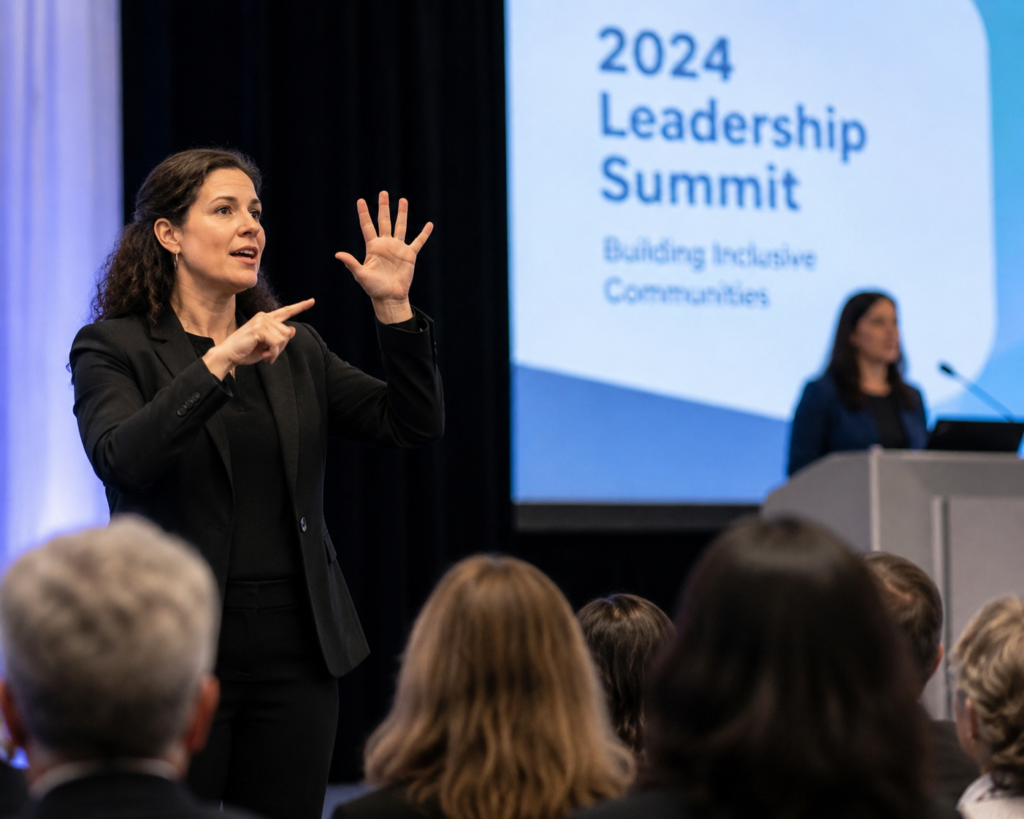
Accessibility for every part of your event
3 Bridges provides ASL interpreting and CART captioning for conferences, conventions, and special events across Austin, Central Texas, and nationwide. From a keynote for a thousand to a breakout for twelve, our certified interpreter teams keep every Deaf and hard of hearing attendee able to follow along, participate, and connect, whether your event is in person, virtual, or hybrid.
Why accessible events matter
Conferences and events hosted by businesses, employers, schools, nonprofits, and government agencies are required under the Americans with Disabilities Act to provide effective communication for Deaf and hard of hearing participants. In practice, that usually means qualified ASL interpreters, CART captioning, or both.
Beyond meeting your legal obligations, accessible events reach a wider audience, improve the experience for every attendee, and show that your organization takes inclusion seriously. We help you get it right, from choosing the right accommodations to coordinating them on the day.
What event organizers should plan for
- Qualified ASL interpreters for presentations and conversations
- CART captioning for attendees who prefer reading English
- Enough interpreter teams to cover concurrent sessions
- Clear sightlines, dedicated lighting, and reserved seating
- A point of contact to coordinate accommodation requests
Event organizers trust us with the details
A great experience for Deaf attendees comes down to preparation, the right team size, and getting positioning and sightlines right. We handle all of it, so accessibility is one less thing on your run of show.
We have served the Central Texas Deaf community since 2010, and we bring the same care to a multi-day convention that we bring to a single appointment.
Qualified interpreters matched to your content
Local roots, nationwide reach
Lighting, positioning, and team scheduling
Rooted in the community we serve
Conferences anywhere in the country
Your event doesn't have to be in Austin. We plan and coordinate ASL interpreting and CART for conferences across the United States, sourcing qualified interpreter teams for your location and handling travel, lodging, and per diem so you don't have to. Tell us the city and the dates, and we'll build and manage the team from start to finish.
How it Works
The earlier we start, the better we can match the right interpreter team to your program.
Book Early
Reach out four to six weeks ahead, or sooner for multi-day or specialized events.
Share Materials
Send agendas, slides, speaker names, and terminology so the team can prepare.
We Build Your Team
We recommend staffing for your sessions, attendee count, and content complexity.
Day of Coverage
Our team arrives ready, with positioning and lighting confirmed before doors open.
A few things that make events run smoothly
Reserve front row seating for Deaf attendees near the interpreter
Provide dedicated lighting on the interpreter, with no backlighting
Send materials in advance: agenda, slides, speaker names, and terminology
Give the team a clean audio feed or quality microphones
Name an on-site point of contact for the interpreter team
Tell us about social functions, pre-recorded content, and your platform ahead of time
Conference & Large Event FAQs
How many ASL interpreters do I need for a conference or large event?
Most conferences and events lasting more than one to two hours require a team of two or more interpreters who rotate every 15 to 20 minutes to maintain accuracy and prevent fatigue. For multi-day conferences or events with concurrent sessions, you may need additional interpreter teams. Contact us with your event details (schedule, number of sessions, content complexity, number of Deaf attendees) and we will recommend the appropriate staffing. Conference interpreting incurs an additional $10/hour per interpreter.
Where should the ASL interpreter be positioned for a stage presentation?
Position the interpreter where Deaf attendees can see both the interpreter and the presenter or screen without turning their head significantly. Typically this means stage left or right, elevated if needed, with dedicated lighting on the interpreter. The interpreter needs a clear view of the presenter, good lighting with no backlighting or shadows on the face and hands, visibility from Deaf seating areas, and minimal visual distractions behind them. Reserve front row seating for Deaf attendees near the interpreter.
How far in advance should I book ASL interpreters for a conference?
Book conference interpreters four to six weeks in advance at minimum. For large events, specialized content such as medical, legal, or technical, or peak seasons, book two to three months ahead. This ensures availability of qualified interpreters familiar with your subject matter. Provide presenters’ materials, agendas, technical terminology, and speaker names in advance so interpreters can prepare for specialized content.
Do you provide ASL interpreters for virtual and hybrid events?
Yes. We provide interpreters for in-person, virtual, and hybrid events. For virtual events, interpreters can appear in a separate video window, picture-in-picture, or spotlight view depending on your platform. For hybrid events, we can provide on-site interpreters, remote interpreters, or both. We work with all major platforms including Zoom, Microsoft Teams, Webex, and streaming services. Contact us early to discuss technical requirements and ensure smooth integration.
What preparation materials should I provide for ASL interpreters at conferences?
Provide interpreters with the event agenda and schedule, presenter names and bios, presentation slides or outlines, technical terminology and acronyms specific to your industry, names of products, companies, or people that will be mentioned, and any pre-recorded content that will be shown. Materials should be provided at least three to five days before the event. The more context interpreters have, the more accurate and seamless the interpretation will be for your Deaf attendees.
Can ASL interpreters cover networking events and social functions?
Yes, interpreters can cover networking sessions, receptions, meals, and social functions at conferences. These informal settings often involve multiple simultaneous conversations, so the interpreter typically stays with a specific Deaf attendee and interprets their conversations as they move through the event. Let us know if your event includes social functions so we can plan interpreter coverage appropriately.
What are the lighting requirements for ASL interpreters at conferences?
Proper lighting is essential for sign language visibility: a dedicated light on the interpreter, not just general stage lighting, no backlighting behind the interpreter, no shadows on the interpreter’s face or hands, and consistent lighting throughout the presentation with no dramatic lighting changes. Light should not shine directly into the interpreter’s eyes. We recommend doing a lighting check before the event to ensure the interpreter is clearly visible from Deaf seating areas.
Do you provide ASL interpreters for awards ceremonies, galas, and formal events?
Yes, we provide interpreters for all types of formal events including awards ceremonies, galas, fundraisers, graduations, and other special occasions. Our interpreters are experienced in formal settings and understand appropriate protocol. For events with entertainment, live music, or performances, discuss these elements with us when booking so we can ensure appropriate interpreter coverage and positioning.
Explore Our Full FAQ
Our full FAQ page covers interpreting, billing, scheduling, legal services, and more.
Let's make your next event accessible
Tell us about your conference or event and we will help you plan the right coverage.